EASA Part-147
Maintenance training for the EASA Part-66 licence — from the classroom to the hangar — delivered through the approved Part-147 organisations in the AAA network: AAA Cyprus for aircraft type training, QCM for basic training.
- Customised programme under Part-147 approval: the Part-66 B1/B2 licence path reduced from five years to two
- 260 hours of theoretical and 540 hours of practical training, examined to EASA standards (75% pass mark)
- Three campuses: operation & examination centre, university training facilities, and partner MRO hangars
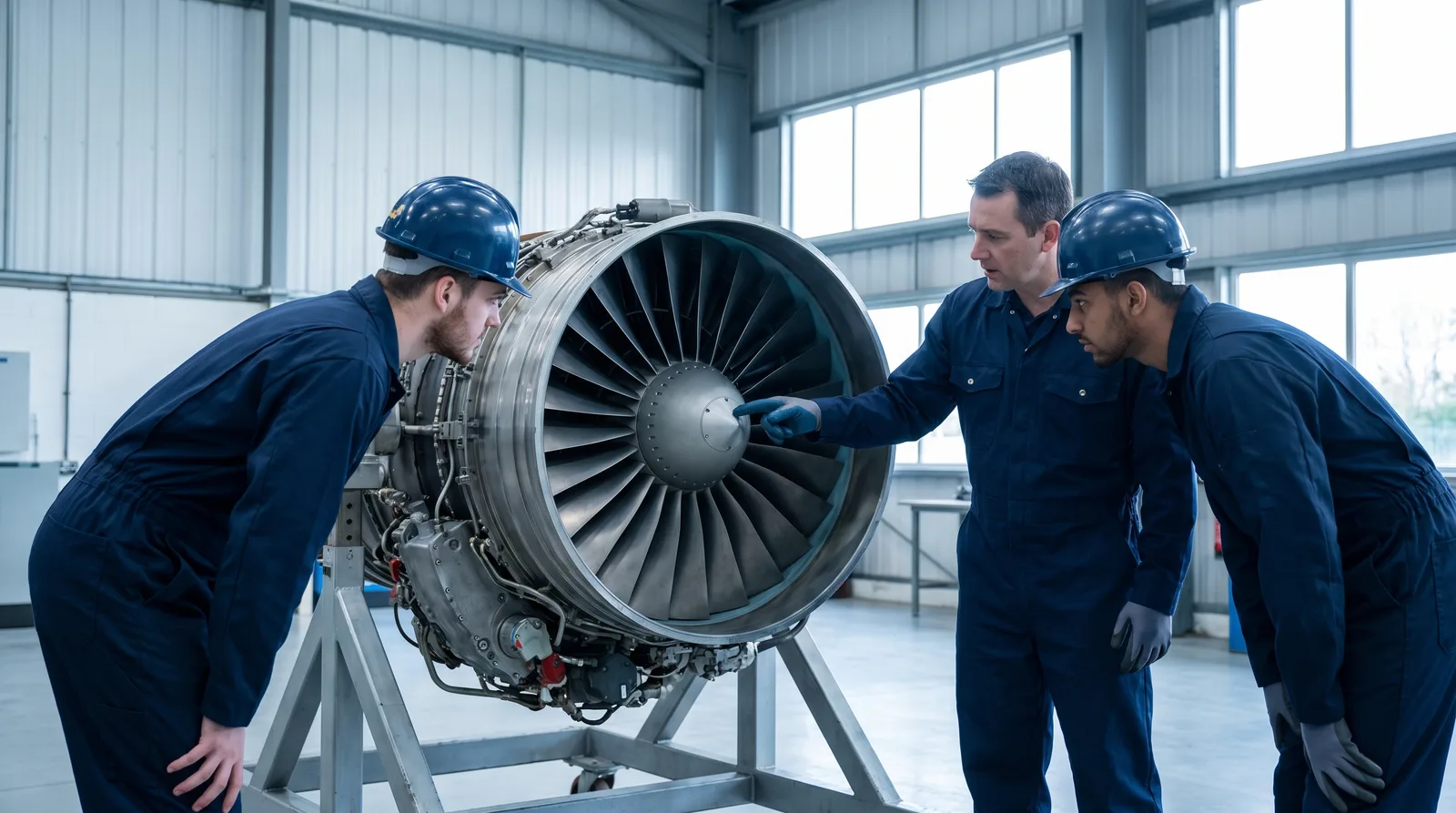
- EASA-certified facilities: classrooms, maintenance practice workshops, electronics/avionics workshop, practical training hangar
- Open to every academic background
AAA Aerospace Engineering
Theoretical classrooms, workshops and practical training hangars on the university campus.
Hangar 901
On-the-job training for aeroplanes (OJT/A) at an approved maintenance centre.
AAA Georgia MRO
On-the-job training for helicopters (OJT/H).
We strongly believe EASA is a worldwide reference standard in the aviation industry. EASA has been responsible for ensuring safety and environmental protection in air transport.
Four reasons engineers choose AAA
Joint education training programme
Through the network AAA has built in the aviation industry, students receive theoretical and practical training from the EASA Part-147 certified programme, and practical training on aircraft at our MRO partners' facilities.
Gateway to opportunities
Based on the course content and language, our courses suit anyone who wishes to become an aircraft maintenance engineer — no previous experience in the field is required.
Key element to the EASA licence
In our EASA-customised approved training programme we reduced the initial training period from five years to two, for the B1 or B2 licence.
Fully equipped training facilities
From theoretical classrooms to practical hangars, every facility is certified by the EASA authority — so candidates get the training quality and knowledge to start their maintenance career.
Aircraft Maintenance Engineer course
A full-time course providing the basic theoretical knowledge and practical experience needed to apply for the EASA Part-66 Aircraft Maintenance Licence (AML) under 66.A-30 — one year of practical experience for Cat. A1, two years for Cat. B1.1.
- Theoretical activities run 6 hours a day in classrooms, in morning and afternoon sessions.
- Practical activities run 7–8 hours a day in the hangar and workshops (sheet metal and electrical/electronic).
- An exam closes every training module — multiple choice and/or essay. The minimum pass mark is 75%, as required by EASA.
- 30% of the practical training is performed in a real maintenance (MRO) working environment.
- Categories covered: A1, B1.1 (aeroplanes turbine), B1.2 (aeroplanes piston) and B2 (avionics).
Modules and credits
Basic technology modules are shared; the specialised stream depends on whether you take the B1.1 mechanical or B2 avionics path.
Basic technology modules
| CODE | MODULE | ECTS |
|---|---|---|
| M1 | Mathematics | 6 |
| M2 | Physics | 6 |
| M3 | Electrical Fundamentals | 6 |
| M4 | Electronic Fundamentals | 6 |
| M5 | Digital Techniques & Electronic Instrument Systems | 4 |
| M6 | Materials and Hardware | 24 |
| M8 | Basic Aerodynamics | 6 |
| M9 | Human Factors | 6 |
| M10 | Aviation Legislation | 6 |
| TOTAL | 68 | |
Specialised — aero-mechanical stream
B1.1| CODE | MODULE | ECTS |
|---|---|---|
| M7 | Maintenance Practices | 24 |
| M11A | Turbine Aeroplane Aerodynamics, Structures and Systems 1 | 16 |
| M15 | Gas Turbine Engine | 12 |
| M11B | Turbine Aeroplane Aerodynamics, Structures and Systems 2 | 16 |
| M17 | Propeller | 6 |
| TOTAL | 74 | |
Specialised — avionics stream
B2| CODE | MODULE | ECTS |
|---|---|---|
| M4A | Advanced Electronics | 6 |
| M7A | Maintenance Practices | 24 |
| M13A | Aircraft Aerodynamics, Structures and Systems 1 | 16 |
| M14A | Propulsion | 8 |
| M13B | Aircraft Aerodynamics, Structures and Systems 2 | 16 |
| TOTAL | 70 | |
Two ways through the programme
Type training
For candidates who already work in aviation and need refresher courses to prepare for the Part-66 examinations. A maximum of four weeks per module is normally enough, with an examination at the end of each month. There is no academic-year programme at this stage — it can start immediately.
Basic training
For high-school diploma holders: 800 hours (one year) of theoretical and workshop training as a full-time academic-year programme, completing the Part-66 examinations under Cat. B1.1. Once the Part-66 certificate is obtained, the student begins two years of on-the-job training at an EASA Part-145 maintenance centre (Hangar 901, Germany), with every exercise registered in the student's logbook.
Can't attend full time?
AAA provides exams on their own, in flexible packages tailored around your existing study or work programme.
Exam
Technicians fully confident about their theoretical knowledge
- Training manuals
- Exams
Tutorial
Technicians who need some help reinforcing their theoretical knowledge
- Training manuals
- Exams
- Video tutorials on key module concepts
Review
A full refresher before the examination
- Training manuals
- Exams
- Video tutorials with added insight
Three campuses
Head operation office
- Operation office
- Examination centre
- AAA hangars
Suranaree University
- Practical training hangars
- Theoretical training classrooms
- Workshops
- Maintenance practice rooms
- Assessment rooms
AAA partners — Part-145 / MRO
- Practical training facilities
- MRO hangars
BSc in Aeronautical Aerospace Engineering (Maintenance)
AAA has developed a programme where students earn a bachelor's degree in addition to the EASA licence — completing the degree modules alongside the two years of practical maintenance experience.
- Seventeen modules in total: fourteen for the B1 (mechanical) licence, twelve for the B2 (avionics) licence, seventeen for both.
- On completing the required modules a Part-66 certificate is issued — the theoretical stage, including workshop exercises.
- After Part-66, two years of on-the-job training follow at an EASA-approved Part-145 maintenance centre, logged in the student's logbook.
- Once the B1 or B2 certificate is obtained, the engineer is authorised to sign the certificate of release to service (CRS) after maintenance.
- Six weeks of workshop training and six weeks of laboratory training, each certified by a qualified engineer in the student's logbook.
Year 1
CERTIFICATE & DIPLOMA- Electronic Fundamentals for Maintenance Engineers
- Electrical Fundamentals for Maintenance Engineers
- Materials and Hardware for Maintenance Engineers
- Mathematics and Science for Maintenance Engineers
- Aviation Practical Skills 1
- Human Factors and Aviation Legislation
- Gas Turbine Engine Technology
- Applied Aerodynamics and Propeller Technology
- Aviation Practical Skills 2
Year 2
BSC- Project and Management 1
- Aircraft Maintenance Management
- Aircraft and Engine Performance 1
- Airline Operations and Quality Management
- Avionics Aircraft Reliability and Fault Diagnosis
- Leadership in Aviation
Year 3
BSC (HONS)- Airworthiness Requirements for Maintenance Engineers
- Aviation Safety Management
- Sustainable Aviation
- Aviation Crisis Management
- Engineering Project and Project Management (double credit)
By 2026 the industry will need 480,000 new technicians — the market is short of licensed aircraft maintenance engineers.
According to ICAO, over the next 20 years airlines will add 25,000 new aircraft to the current 17,000-strong commercial fleet. Boeing and Airbus are setting up MRO facilities worldwide, creating thousands of jobs for aircraft maintenance engineers.
Where licensed engineers work
Airlines
A licensed engineer analyses and resolves aircraft defects and signs the flight release certificate before an aircraft may fly.
MRO industries
Maintenance, repair and overhaul companies working on aircraft and components — engines, landing gear, airworthiness.
Aircraft manufacturers
Boeing, Airbus and others hire maintenance engineers to maintain and operate engines and electronic systems.
Parts manufacturers
Engineers analyse aircraft parts in production and help build better ones.
Aviation authorities
EASA, ICAO and similar organisations dealing with the safety and security of civil aviation.
Training centres
Experienced engineers teaching the next generation of aircraft maintenance engineers.
Flying clubs
Clubs providing members with affordable access to aircraft that must be maintained by licensed engineers.
Civil defence forces
Defence fleets are maintained by licensed aircraft maintenance engineers just as civil fleets are.
These certified courses are for anyone wishing to start a career in aviation as a certified engineer. Because of the course content and duration, no previous experience or knowledge in the field is required. Knowledge of English is necessary — all training activities and materials are in English.
Talk to the organisation that does this work
Tell us what you need and we will put you in touch with the right AAA organisation — with the people who fly, maintain or teach it.